Small numbers
Small numbers in mathematics are no less interesting than numerical giants. These are numbers that are as many times less than one, as much as one less than a numerical giant.
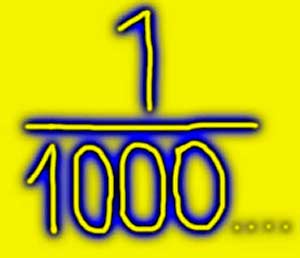
Small numbers can be obtained by writing a series of numbers that are inverse to a million, a billion, a billion, etc., that is, divide the unit by these numbers. The resulting fractions:
can be designated as follows 10-6, 10-8, 10-9.
Do you ever really have to deal with such small numbers?
Many are mistaken if they think that nothing could have happened in such a short time as 1/1000 seconds. For example, sound in the air during this time interval is transferred to 33 cm, and a bullet with a speed of 700-800 m per second, is transferred to 70 cm. The earth, in its circulation around the Sun, moves every 1000th fraction of a second by 30 m, and lightning during this time has time to arise and stop.
It turns out that a millionth of a second is also not an extremely short period of time! This is a small number, during which, moving at a speed of 300000 km per second, a beam of light manages to move to a distance of 300 m - about the same as how much air is carried in the air for a whole second. In addition, within 1000000th of a second, 400 million red light waves enter our eye, and one wave hits the eye during the 400000000000000th its fraction!
Small numbers can be met by measuring and estimating distances. For example, to measure bacteria and other small objects, scientists turn to a micron, which is 1000 times smaller than a millimeter. The red blood cells of our blood have a length of 7 microns and a thickness of 2 microns, and the constituent molecules of atoms have sizes from one 100th to one 1000th micron.
To imagine these small numbers, we will mentally increase all objects on the globe by a million times. For example, people would be as large as 1700 km. Red corpuscles, billions floating in our blood, would have each more than 7 m in diameter, and hair would have 100 m in thickness. How many sizes will there be with such a monstrous increase in the atom of matter? In this case, its dimensions will not be greater than the typographical point on a sheet of paper!
Have we reached the smallest numbers here? It is established that the atom is a whole world consisting of much smaller particles. For example, a hydrogen atom consists of a central core and an electron circulating around it rapidly. An electron, for example, is so much smaller than a speck of dust, as much as a dust particle is smaller - the globe!
It is possible to compile a chain of small numbers, each link about a quarter of a million times larger than the previous one and as many times smaller than the next: electron, atom, particle, house, globe, solar system, distance to the Polar star, Milky Way.
