Irrational numbers
Irrational numbers were discovered in the Pythagorean school when trying to measure the diagonal of a square with its side. The Pythagoreans attributed the numbers to the divine power, and the Pythagorean system of knowledge consisted of four sections: arithmetic (the science of numbers), geometry (the doctrine of figures and their measurement), music (the doctrine of harmony) and astronomy (the doctrine of the structure of the universe, which they called the word "space"). His law - "everything is a number", Pythagoras and his disciples spread everywhere where possible, including the structure of the universe, but it turned out that the diagonal of the square with side 1 (the square of its length, according to Pythagoras theorem, is 2) was not expressed by the ratio of numbers (i.e., fraction).
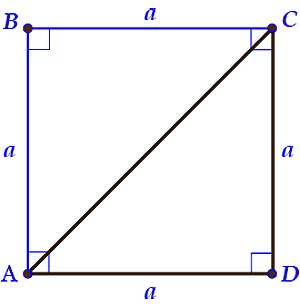
The square root of two is an irrational number. With this number is connected the discovery of the so-called "incommensurable segments" and the history of the most dramatic period in ancient mathematics, which led to the development of the theory of irrationalities and irrational numbers. Following this irrationality, many other irrationalities were discovered. Thus, Theodore of Cyrene established the irrationality of the square root of the numbers 3, 5, 6, ..., 17, and Teetet (the beginning of the 4th century BC) gave one of the first classifications of irrationalities. There is a legend that one of the pupils of Pythagoras, Gippas, amused himself with the number "square root of the two", trying to find him the equivalent of a simple fraction. Gippas suddenly realized that such an equivalent does not exist. Irrational numbers destroyed the teaching of Pythagoras about the harmony of the world, and hence Pythagoras himself lost the meaning of existence. For this Pythagoras sentenced his disciple to death through drowning.
Irrational numbers have significantly influenced the further development of mathematics and philosophy. The basic principle of Pythagoreans turned out to be false: "everything is a number" (meaning a natural number).
Unlike rational numbers, the numbers expressing the ratio of incommensurable quantities were called in the ancient times irrational, that is, irrational, although originally the terms "rational" and "irrational" were not related to numbers, but to commensurate and, accordingly, incommensurate The quantities that the Pythagoreans called expressible and ineffable. Theodore of Cyrene, the teacher of Plato, called these numbers symmetrical and asymmetric. In the 5-6 centuries. Roman authors Martian Capella, author of the popular in the Middle Ages encyclopedia of the seven liberal arts, and Magnus Aurelius Cassiodorus (487-578 (5)) translated these terms into Latin with the words "rationalis" and "irrationalis". The Greeks called the irrational value (for example, the square root of the two) by the word "alogos" - ineffable words.
The term "irrational" first appeared in the middle of the 12th century, it was introduced by Gerard Cremonsky - a well-known translator of mathematical works from Arabic into Latin; then it began to use the Italian mathematician Leonardo Fibonacci, and after a while the term became popular with other European mathematicians, until the 18th century. But the needs of war forced mankind to learn to solve algebraic equations to a degree higher than the first. In Europe in the 16th century. such scientists as the Italian mathematician Rafael Bombelli and the Dutch mathematician Simon Stevin, considered irrational numbers to be equal in numbers with rational numbers. Only in the second half of the 19th century. German scientist Richard Dedekind (1831-1916) gave one of the strict theories of irrational numbers.
Since irrational numbers can not be written in the form of a finite number, we must put the signs "approximately equal" or ellipses and be limited to some necessary number of decimal places.
