Tikal
Tikal is the largest and most studied monument of the classical Mayan era. This city is located in the north of Guatemala in the department of Petain, in a zone of humid tropical forests.
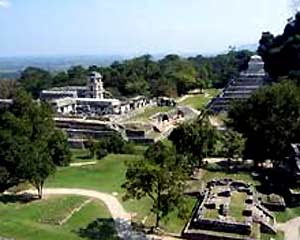
In the mid-19th century, Ambrosio Tut, the Governor of the Petain Department, rediscovered this huge city of ancient Maya. In the years 1956-1967. in Tikal worked the archaeological expedition of the Museum of the University of Pennsylvania (USA). Excavations have shown that Tikal was the largest city of the classical period, not only in the Maya region, but throughout the Western Hemisphere. According to the dates preserved on the stone monuments of the city, Tikal existed from 416 to 889 AD.
In the 8th century AD, at the time of its highest flowering, Tikal occupied quite a considerable territory. The city center - "Acropolis", built up with numerous temples and palaces, was located on an area of 2-2,5 square meters. km, occupying the top of a hill, surrounded by lowlands and grass. Within this central core surrounding the main square of the city, up to 3 thousand buildings of various purposes and sizes were concentrated, including all large public buildings - temples and palaces (totaling about three hundred). The "Acropolis" was decorated with numerous monumental structures covered with magnificent carvings - steles, altars - there are more than two hundred of them. The most important ensembles were connected among themselves by wide roads lined with white limestone slabs.
According to the estimates of the researchers, during the heyday (8th century), 11.5-12 thousand people lived in Tikal, and the entire area of the city with the district ranged from 123 to 160 square km.
For a long time depopulated Tikal is now surrounded by impenetrable tropical jungles, which are home to jaguars and tapirs. The center of the town of Tikal, located on a limestone platform, is surrounded on two sides by deep ravines. The five main architectural complexes of Tikal are connected with each other by well-preserved "avenues". The pyramids of Tikal are distinguished by a specific style, not found anywhere else. The height of the largest pyramid of Tikal is more than 70 m.
The gigantic city of Tikal is famous for its many stele (there are 83 of them) and altars (54). On the reliefs, stelae and paintings of Tikal, the rulers of the city are depicted in everyday affairs and worries: here you can see the scenes of accession to the throne, palace audiences, victorious battles, deity worship, ritual acts, etc.
Studying the numerous finds of Tikal ceramics, the researchers have identified the last two stages in the history of the city: Imish and Esven. The first of them lasted from 700 to 830. It was during this period that five of the six huge temples, six pyramids and dozens of huge palaces were built in Tikal. The maximum size has reached the population of the city.
Ceramics such as "eshn" directly comes from the traditions of ceramics "imish" and follows immediately after it. But what a contrast in the general appearance of these two periods!
According to scientists, the population of Tikal during the era of "esnash" was no more than 10 percent of what existed in the city during the period of "imish". At the beginning of the "esnab" (9th century), all architectural construction ceased in Tikal, the population sharply decreased. Hundreds of dwellings have deserted. Luxury palaces collapsed - people still living in them literally fell on their heads dilapidated roofs and plaster. The surviving remnants of the once powerful people could not last long among the wreckage of the former greatness. And 100-150 years after the construction of the last dated stele in the city of Tikal was finally desolate.
What happened? Because of what unknown to us reasons Maya left Tikal? There is still no complete clarity on this issue.
In the material culture of Tikal there are no traces of invasion by foreign invaders: burnt and collapsed buildings, broken weapons and randomly piled skeletons with broken skulls.
A certain popularity is enjoyed by the hypothesis put forward by the first known American scientist Eric Thompson. In his opinion, the decline of Tikal and other classical centers of Mayan culture was associated with internal social upheavals. During the excavation of Tikal archaeologists were surprised to find that almost all the stone sculptures depicting rulers and gods were either intentionally damaged or destroyed. But who did this? For what purpose? According to Thompson, only the uprising of the oppressed lower classes could be discussed here.
In any case, broken and intentionally damaged monuments with the faces of kings and gods are found not only in Tikal, but also in Piedras Negras, Iashchi-lan, Altar de Sacrificeos. The huge and flourishing country has suddenly experienced the devastating consequences of the most severe social crisis. After a while, the victorious farmers dispersed in their villages, scattered around the surrounding forests. And the mighty Maya cities enveloped the dead silence.
This hypothesis is met with numerous objections. As studies have shown, there is practically no real evidence in favor of this development. It turned out that in Tikal and in other Mayan cities of the classical period, stelae and altars with images of rulers and gods were spoiled and destroyed not only at the end of the 1st millennium AD, but throughout the centuries-old history of the local civilization. It was some important ritual or rite: after a certain cycle of time, the monument was spoiled or broken up, thus committing its ritual "murder". But even after this act, he continued to be an object of zealous veneration on the part of the Maya: he was offered sacrifices and gifts.
The mystery of the death of Tikal, like, indeed, the entire classical Maya civilization, remains open.
