Monte Alban
Is there any other piece of land on the earth whose history would have been just as dark? So wrote about Monte Alban one famous journalist who visited this archaeological reserve, located in the southern part of Mexico, near the city of Oaxaca. For almost two millennia here was the largest center of pre-Columbian America - an ancient Indian city, whose name history has not preserved. Today it is called Monte Alban - by the name of a forested hill, for many centuries hiding the ruins of a huge Indian settlement, in which people of surprisingly high culture lived. This talented people was called zapotek. They built magnificent temples, were able to process rock crystal, to make gold things and other jewels of extraordinary beauty. In 1931, Monte Alban was excavated by the Mexican archaeologist Alfonso Casso, and this discovery is equated to the opening of Troy by H. Schliemann.
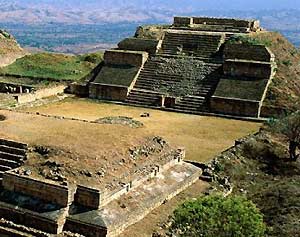
Monte Alban was founded around 4 century BC. At the time of its heyday (200-700 AD) the city occupied an area of 40 square kilometers, and its population exceeded 20 thousand people. On the artificially leveled giant square, and today stepped pyramids with a platform for playing ball. On the slopes descending the terraces there are remains of palaces, stelae with inscriptions, a stone staircase with a width of 40 m and other structures. The walls of the buildings were decorated with mosaics, frescoes, reliefs.
But much more interest than temples, palaces and steles, represent the famous tombs in Monte Alban, which are built of stone, and each is covered with a large stone slab on top. The Zapotecs believed that their ancestors at the dawn of history were born from large caves, and in the same way they should return to the world of the deceased.
The discovery of the tombs of Monte Alban was a real shock to scientists. It turned out that they are packed full of unheard-of beauty and value with gold products!
The first tomb in Monte Alban archaeologists discovered in the autumn of 1931. On January 9 next year Alfonso Casso and his assistant Juan Valenzuela saw a real miracle. When Valenzuelo made his way through the narrow hole to the newly discovered tomb (she received the number seven), he thought he was losing his mind: he saw a huge treasure that had been buried untouched for more than eight hundred years... More than one and a half hundred tombs were discovered by archaeologists in Monte Alban. But none of them, according to their wealth, surpassed the famous "Tomb No. 7". Seven days were needed in order to endure the treasures. In total, about five hundred items were found, including the magnificent golden mask of the god Shipe Totek, necklaces of unusually large pearls, earrings from jade and obsidian, gold hammered bracelets with convex ornament, gold necklaces consisting of 900 links, buckles and buckles of jade, turquoise, pearls, amber, corals, obsidian, jaguar teeth, bones and shells.
Here, mysterious human skulls, carved from pure rock crystal, were found. But crystal is one of the hardest minerals on earth. As it turned out, the crystal skulls were made of a whole crystal of quartz. Their surface did not have the slightest trace of any processing with metal tools and was, apparently, polished with a special paste, the secret of which has not reached our time. But, according to the most conservative estimates, in order to make it in this way, the Indians would need at least 300 years!
At the turn of the 14th-15th centuries AD the Zapotecs were expelled from Monte Alban by the Mishtecs. They moved their capital to the city of Joopaa. The Aztecs called it "Mitla" - "The dwelling of death". According to the ideas of the Indians, here was the entrance to the underworld, the gateway to the afterlife. Pilgrims from all over Mexico flocked to Joopa to wait for their death.
