Memphis
Twenty-five kilometers south of Cairo, a millennium ago, was the capital of the ancient Egyptian state - Memphis. Now this place is called Mitrahine. Memphis was founded at the end of the 4th millennium BC and was the first capital of the united Egypt. According to legend, the city, located on the border of Upper and Lower Egypt, was founded by King Meni, the unifier of the country.
According to the Greek historian Herodotus, Memphis was founded in the great bend of the Nile, which, at the behest of Meni, was drained and protected by a dam. Here Meni ordered to build a fortress with the famous "white walls" and the great temple of the god Ptah. "Even now, the Persians are very concerned about this besieged dam of the Nile Bend and every year strengthen it. If the river breaks through here the dam and spills, then Memphis is threatened with complete flooding", Herodot wrote.
Favorable location in the Nile Delta contributed to the rapid growth of the city. Memphis has become not only the capital of the state, but also the center of its culture. Here, in connection with the veneration of the local god Ptakh, one of the most important religious and philosophical teachings of Egypt was formed. Memphis artists created beautiful monuments that had a huge impact on the formation of Egyptian art. In addition, the city of Memphis was the center of trade, a river port, there were shipyards, artisans minted in gold, metal, weapons and ceramics.
The rulers of the Old Kingdom took care of the city of Memphis most of all. They expanded it, leading the palace development in the direction of the current Giza. After the fall of the Old Kingdom, Memphis was never a permanent residence of the kings, but it was always considered the "true" capital of Egypt. Wherever the Egyptian rulers lived, concern for the expansion and adornment of Memphis was considered a prestige issue for them, and foreign conquerors considered Egypt conquered only after spending the night in the walls of Memphis.
The greatest flowering Memphis reached at Ramesses II, who appointed his son Haemves the high priest of Ptah. Despite the fact that the Assyrians, and then the Persians plundered Memphis, in the time of Herodotus it was still a lively city with quarters and temples inhabited by Greeks, Phoenicians, Libyans, Arameans, Jews. It had about a million inhabitants. Ancient Roman geographer Strabo, who visited Memphis at the turn of the new era, wrote that this city "is more and more elegant than others". Pliny was delighted with his palm groves.
The founding of Alexandria put an end to the further development of Memphis, but he continued to maintain his religious significance. The final decline of the city was caused by the abolition of the cult of the god Ptah. Heavy damage was inflicted on Memphis during religious rivalries of the 3rd and 4th centuries AD. His temples were devastated, giant statues of gods and pharaohs were destroyed, palaces were plundered. The population left him in droves, the famous decree of Emperor Theodosius against the Gentiles (393) was read here among the ruins.
When the Arabs entered the city, they found on the site of Memphis only a huge amount of construction material, which they had for many centuries and which they used to build Cairo. Arab traveler Abd al-Latif in the late 12th century still found the ruins of Memphis and admired them ("for their description and the most eloquent person does not have enough words"); but already in the 14th century the geographer of Abu-l-Fida wrote only about the huge area that the city once occupied. Then the floods of the Nile erased all traces of the existence of the ancient Egyptian capital.
The place where Memphis stood was found only in the early 19th century. The first attacks were pierced by sappers of the Napoleonic expeditionary army, but the scientists were not yet quite sure that his location was correctly determined. Only later excavations have cleared up a lot.
It turned out that even the messages of the ancient authors could not convey the grandeur of the ancient Memphis. Particularly striking were its dimensions: the pedestrian needed four hours to pass from one end of the city to the other. The city was an endless chain of individual villages, temple sites, palaces with parks and gardens, separated from each other by fields and gardens.
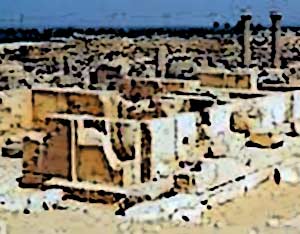
These ruins, and a lonely sphinx hanging in the midst of a sea of sand, seem to be all that has survived today from once-million Memphis. But that's not all. Because without Memphis there would not be what is today the glory of Egypt - the famous fields of tombs and pyramids that were tombs of Memphis pharaohs.
