Nasca culture
The southern coast of Peru is the most arid region of the country. It was here, in the valleys of Nazca and Ika, the German scientist Max Ule at the turn of the 19th and 20th centuries. discovered traces of one of the most interesting and in many ways mysterious cultures - it is the Nasca culture pre-Columbian America.
The first finds of Ule were the burials that the Nazca culture left - a lot of burials in which he found vividly painted vessels, fabrics, gold, wooden objects. These graves belonged to two cultures: the late (9-16th centuries), later called the ika, and the early one - the Nazca (3rd century BC - 6th century AD).
The culture of the Nazca derives its name from the Nazca valley of the same name, located 80 km from the coast Pacific Ocean and separated from it by the desert. The culture of the Nazca did not leave monuments of monumental architecture after it - only traces of small rural settlements reached us. Nevertheless, the inhabitants of Nazca - the skilled potters and weavers - occupied an exceptional place among the modern inhabitants of the American continent. Craftsmen from Nazca were known for embroidery, carpets and brocade production, as well as other types of weaving machinery. In order to get an idea of the magnificence of ancient Nazca fabrics, it is enough to mention that during their production a wide range of colors was used, including 150 basic colors and minor shades.
The Nazca's covered canals are also unique. Some experts compare them with similar facilities in Iran and North Africa. They were designed to drain mountain waters into populated valleys. In Nazca, apparently, there were no architects who built churches, but there were experienced builders of hydraulic structures.
The ceramics of the Nazca culture is distinguished by a thin and bright multi-color painting. Now at the disposal of archaeologists was a lot of vessels of this culture. Obviously, this dish was intended for funeral rites. At the same time, at an early stage in the development of the Nazca culture, the vessels differed slightly depending on where they were made.
Vessels of the Nasca culture are covered with bright, motley images of animals, birds, plants, mythical creatures. These images are transmitted in a laconic and somewhat conditional manner. Often the same motif is repeated, colored in different colors. On one list of such colors is 7-8, and considering shades, - and more.
The severed heads are one of the main motifs of the Nazca murals. The severed human heads, either brought to unrecognizability, or naturalistically executed, form whole belt-friezes or black forked curls and spirals, dotting surfaces and protrusions of vessels on the painted vessels of the Nazca culture. Mythical characters hold severed heads in their hands and devour them. If the vessel depicts people-priests, then next to them on the altars lie the same head. What is the reason for such vampirism? What do we even know about the culture of the Nazca?
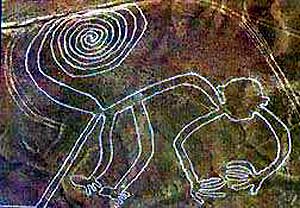
It is known that technically it was more primitive than other Andes civilizations. Indians of the Nazca did not know the metal, did not use the potter's wheel. Their magnificent dishes they made by hand, burning it in a pile of hot coals, and the walls of their houses were made of clay clods. And yet the culture of Nazca can not be called primitive. This, in particular, is evidenced by the ruins of Kauachi, the main center of Nazca culture. And, of course, you can not ignore the biggest mystery of this civilization - the famous drawings in the desert Nazca.
Figures of animals laid out on a specially constructed plan in scale, which was transferred to the surface of the earth with the help of ropes attached to stone-markers, some of which can be seen today.
How did the Indians of the Nazca culture depict animal figures with such precise outlines and accurately sized dimensions?..
The American Bill Sporer relied on the fact that the people of the Nazca culture who created these drawings in the desert probably came from two similar peoples, known as culture paracas and chaska. These agricultural peoples are known for their success in the art of weaving and decorating clay products, and this gave Sporer a clue. Four pieces of a fabric of a nask from the plundered tomb found out near to Peruvian drawings, have been investigated under a microscope. It was found that the ancient Peruvians used the best interlacing in their fabrics than we use in making modern parachute fabric and stronger than in modern balloon fabrics: 205 by 110 threads per square inch, compared to 160 by 90. And on clay pots of Nazca culture Sporer discovered images of objects resembling balloons and kites with flying ribbons. On many tissues of the Nazca culture, flying people are depicted. Sporer stumbled upon the ancient Inca legend of a small boy named Antarqui who helped the Incas in battle, flying over the fortifications of the enemy and reporting the location of their squads.
Another mystery of the culture of the Nazca is in the so-called "fire pit", which ends many straight lines drawn through the desert. These are round holes approximately 10 m in diameter with charred stones. Sporer, along with several other researchers, studied these stones and made sure that they were blackened by the impact of a strong heat source. Maybe there was a large fire at this place, which warmed the air inside the balloon?
In November 1975, Sporer's reasoning was subjected to practical verification. Using only those materials and technologies that could be available to Indians of the Nazca culture, a balloon was built. Under it, the fire was lit, and the ball went on a flight with two pilots in a reed basket...
