Rayleigh waves
In 1885, the English physicist Rayleigh conducted research on acoustic surface waves that propagate along the surface of the globe, not leaving in its depths. Rayleigh waves, as they were later called, played a huge role in the birth of a new science - acoustoelectronics. But first the scientists simply forgot about them. Even in the second half of the 20th century. it was not at all clear whether it was worthwhile to deal with them again.
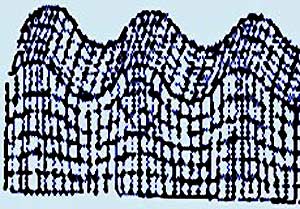
Rayleigh waves are special, unlike other known types of waves. The thing is that atoms form a crystal lattice in a solid, and the displacement of one atom is transmitted to all its neighbors. The mechanical effect on atoms in a solid generates sound waves in it. When a longitudinal wave propagates, the crystal undergoes alternating compression and stretching in the direction of wave motion. The deformation rolls along the entire length of the crystal. Another type is a transverse one, or a shear wave causes vibrations of the lattice atoms in a direction perpendicular to the wave propagation. Longitudinal and transverse waves have one common property: they propagate throughout the thickness of the crystal, that is, they are three-dimensional.
In crystals in a thin surface layer several tens of microns thick, Rayleigh waves can arise. But the particles of matter, at the same time, oscillate both in the longitudinal and in the transverse direction. Along with compression and stretching, the layers of matter are shifted parallel to each other. It is also interesting that Rayleigh waves are easy to excite and take at any point on the surface of the crystal.
Is it possible to turn electrical signals into sound Rayleigh waves that can be changed during the motion along the crystal, and then converted again into electrical signals? In this case, the crystal can serve as a converter of electrical signals, like semiconductors.
In this case Rayleigh waves were supported by piezoelectric crystals, discovered in 1880. Mechanical deformations in the piezoelectric crystal cause in it the appearance of internal electric fields. Conversely, the electric fields applied to such crystals generate mechanical stresses of the same frequency in them.
For this purpose, two silver electrodes were sprayed onto the surface of the crystal in vacuum, having supplied an alternating electric signal to them, excited acoustic waves in the crystal. When the deformation reached the other end of the crystal, an alternating electric charge appeared on it, which was adopted with the help of another pair of similar electrodes. But the signal on them was much less than the input. We tried to use several pairs of exciting electrodes at once, placing them one after another, on one of the ends of the crystal. If the distance between the pairs of electrodes is made so that the Rayleigh waves pass it in a time exactly equal to the period of the oscillations, then the Rayleigh waves, catching up with each other, will mutually amplify and a rather powerful electrical signal will appear at the output, which is several tens of percent less than the input . How can we make the Rayleigh waves amplify while traveling inside the crystal?
An electromagnetic wave can be represented in the form of quanta of electromagnetic energy - photons, and a sound wave as a flux of quanta of sound energy - phonons. Like particles, phonons can collide with each other, as well as with other particles, for example, with electrons. Having created a potential difference at the ends of the conductor, an ordered motion of electrons will appear in it. Let us now launch a sound wave in the same direction. If the velocity of the electrons is less than the velocity of the wave, then the phonons, colliding with the electrons, will give them some of their energy. Electrons start to accelerate, and the wave - to weaken. And vice versa. If the electrons move faster than the wave, they catch up with the phonons and give them their energy. There will be an increase in the sound wave.
In 1964, the physicists Yu. Gulyaev and V Pustovoit have thus intensified the Rayleigh waves hundreds of millions of times, spraying the semiconductor onto the surface of the piezoelectric. It turned out a kind of puff. Electrons flow to themselves in a semiconductor, and sound Rayleigh waves - in a piezoelectric. At the interface between the two materials, a race of electrons and phonons occurs. At this boundary, the sound Rayleigh waves are fitted to the electrons, amplifying them.
