Laser
Laser - a short and unusually popular nowadays word became the common name of a huge class of devices that were so widely used in science and technology that, following the expression "atomic age" in our lexicon, the expression "laser age".
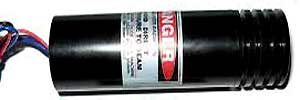
The idea of creating lasers was first proposed by the Soviet scientist V.A. Fabrikant owner was in 1940, but at that time it was not realized. In the early 1950s, Academic scientists N.G. Basov and A.M. Prokhorov and independently of them the American physicist C. Townes suggested such methods of action on substances (gases, crystals, etc.) that allow you to get quite strong radiation and create devices that use it. This scientist was awarded the Nobel Prize for the work that led to the creation of lasers.
The laser radiation can be continuous, with constant power, or pulsed, reaching extremely high peak powers. In some circuits, the laser working element is used as an optical amplifier for radiation from another source. There are a large number of types of lasers using all aggregate states of matter as the working medium. Some types, for example lasers on dye solutions or polychromatic solid-state lasers, can generate a whole set of frequencies in a wide spectral range.
The laser has an unusually high specific power - up to 108-1012 W/m2. This is hundreds of millions of times greater than the power that can be obtained by focusing the strongest lenses on sunlight. The ability to concentrate a small amount of energy in a small volume and defined the scope of application, for example, laser processing of superhard materials.
In medicine, the laser replaces the surgical scalpel, and its radiation is used to treat retinal detachment. Using a laser, a method was developed for recording volumetric images of objects on a flat plate - holography, which has become not only an entertaining spectacle, but also an effective means of scientific research. The laser is increasingly strengthening its position as a means of communication. There are also high hopes of solving the problem of controlled thermonuclear fusion with lasers.
It is impossible to enumerate all the areas where the laser is used, it is even harder to guess where and how it will be used in the near future. Reality is often richer and more diverse than fantasy.
