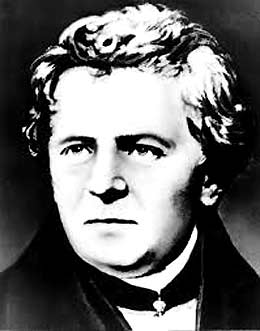
Georg Ohm
The German physicist Georg Ohm (1787-1854), who discovered Ohm's law, familiar to all schoolchildren today, in 1826 for publishing a short article in which a well-known law was being published, the Cologne school teacher Georg Ohm was dismissed from work on personal instructions Minister of Education. The minister was convinced that the introduction of mathematics into classical physics was an unacceptable heresy. And he ordered all the inspectors to keep an eye on the purity of natural philosophy and to regard it as the main speculative approach to the phenomena of nature.
In Germany, not only the teachers listened to the minister, but also the scientists. The law of George Ohm was recognized first in Russia thanks to the works of B.S. Jacobi and E.X. Lenz, and then in France and England. In Germany, even did not admit the idea that it is impossible to learn the laws of physics without mathematics. The very work of George Ohm frankly ridiculed for "a painful fantasy that reduces mathematics to the dignity of nature".
Georg Ohm was forced to retire for a few years then scientific activity. He engaged in self-education and after a while released a series of brilliant works on electricity, acoustics, crystal optics, in which mathematical formulas were widely used. He introduced the concepts: "electromotive force", "voltage drop", "conductivity", etc. In 1839, 13 years after his expulsion from school, Georg Ohm became a corresponding member of the Berlin Academy of Sciences.
In 1849, Ohm, already very famous, was invited by the professor of physics in Munich and appointed there as a conservative of physico-mathematical collections of the Academy of Sciences. He remains here until his death, which followed on July 6, 1854. He was buried in the Old Southern Cemetery. In Munich, in 1892, a monument to George Ohm was erected, and in 1881, at an international congress of electricians in Paris, it was decided to call his now-accepted unit of electrical resistance ("one ohm").
The most famous works of Georg Ohm dealt with the issues of passing an electric current and led to the famous "Ohm's Law", which connects the resistance of the electric current circuit, voltage and current strength. In his first scientific work, Georg Ohm experimentally examines these phenomena, but, due to the imperfection of instruments, he comes to an erroneous result. In the subsequent work Georg Ohm formulates his famous law and then unites all his works on this issue in the book Die galvanische Kette, mathematisch bearbeitet, in which he gives a theoretical conclusion of his law, starting from a theory analogous to the theory of Fourier heat conductivity. Despite the importance of these works, they went unnoticed and were even met with hostility, and it was only when Puglia in France again came to the same results by experience, that the Ohm's law was accepted by the learned world, and the Royal Society of London on November 30, 1841 awarded George Ohm the Copley medal.
