Electromachines
What is electromachines? These are electromotors, which convert electric current into mechanical motion. In addition, the electric machines include generators, performing the reverse task - the transformation of mechanical motion into an electric current.
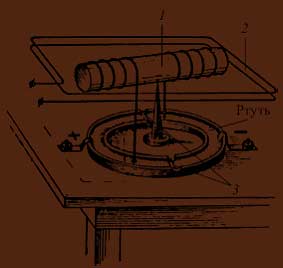
The world's first electric motor was created by Faraday. At that time, the principle of its operation remained incomprehensible. In 1828 the Hungarian inventor Anos Edlika constructed, so-called, an electromagnetic self-rotator. His electric machine resembled modern collector electric motors, which operate from a direct current.
The principle of operation of the self-rotator Edlika is the automatic magnetization reversal of the electromagnet in such a way that its poles are interchanged, depending on the position of this electromagnet. Yedlik placed the electromagnet with the core on the point of the support, like the arrow of a compass, and placed both ends of its winding in two semicircular cups with mercury, isolated from each other. To one cup was connected the positive pole of the battery, and to the other - negative. Cups with mercury played the role of ordinary current collectors, only with much less friction. Above the electromagnet was a winding connected to the current source.
Subsequently, the mercury semirings were replaced by copper plates, the ends of the windings carried graphite contacts-brushes-but the principle of the electric motor remained the same. Unless the number of poles of a rotating electromagnet - an armature or a rotor - is increased. Increased and the number of copper plates at the ends of the windings, and they began to unite in the collector. Two plates on the collector were left only with the most low-power toy motors. Permanent magnets on the stationary part of the electric motor - stator - have been replaced by electromagnets and have received almost what we see in electric vehicles today.
If we supply current to such an electric machine, the rotor or armature starts to rotate, transferring the rotation to the shaft. If we ourselves rotate the shaft of the electric machine, we can remove the current from the brushes or from the stator windings. Not all electric machines work equally well in the modes of both an electric motor and a generator. For example, an automobile starter for starting an engine is a typical electric motor, but it is no good at all as a generator. A modern car generator - the same unsuitable electric motor. But there are electromachines that work equally well both as a motor and as a generator, they are called reversible. This property is widely used in engineering, in particular, in the accumulation and allocation of energy.
In 1838 electric motors appeared on the first electric vehicle, which was born much earlier than the first car with an internal combustion engine. It was built by an Englishman R. Davidson in London and tested there. In the same year, the Russian engineer B. S. Jacobi installed an electric motor of his design for a boat of 8,5 and a width of 2,1 m, in which 16 people were accommodated. The boat made a sensation when tested on the Neva in St. Petersburg, as it could move not only along the river course, but also against it. Engine power was only 0,5 kW, insignificant by today's standards. Eater was powered from galvanic cells.
Since then, electric DC machines have not changed fundamentally.
