Man as a machine
Descartes, a great thinker of the 17th century, regarded man as a machine. A modern scientist would be more inclined to call our organism rather a factory than just a machine. Man is a "plant", which has its own special "technique." In this plant there is a division of labor, - different organs perform a very definite function, - and their own control system with the help of nerves. These nerves, connecting the various organs of the body with the brain, resemble the telephone network of a large factory.
One of the main organs of the human body is the heart. The heart is a machine weighing only 300 g. Its capacity is about 1/375 horse force. Normally, this live machine works 70-80 years without interruptions and does not require - or rather does not - repair. With each stroke, the heart-machine does a job sufficient to lift 400 g to a height of one meter. With each stroke, the heart drives out from the veins 1/10 liters of blood into the right atrium, from there to the right ventricle and then, through the pulmonary artery, to the lungs, where the blood is purified by oxygen inhaled by us. From the lungs, the renewed blood passes through the pulmonary vein into the left atrium, then into the left ventricle and from there into the large aorta. Thanks to this machine-heart, blood nourishes all the organs, skin, nerves... Within one minute the heart pumps 7 liters of blood (about 30 glasses); per day it will be more than 5000 liters, and for the year of life 4000000 liters, i.е. eight thousand forty-kilo-barrels!
And this machine, created by nature, working without repair for dozens of years, weighs only 300 g. Such a machine will envy any factory. Is it because many inventors tried to imitate nature?
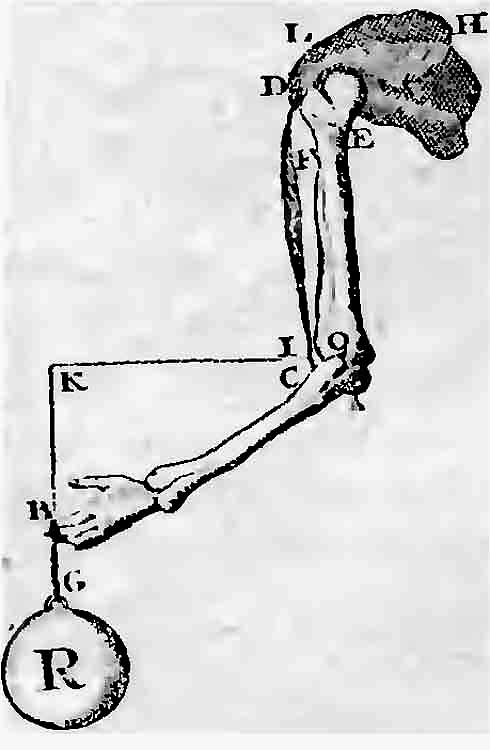
That our hands are remarkable levers, knew Borelli, a pupil of Galileo, a contemporary of Descartes. Figure 1, which you see here, is taken from Borelly's remarkable essay "On the movement of animals". This scientist showed that the force acting in the muscle is applied to the smaller lever arm and therefore significantly exceeds the load acting on the end of the finger (the "B" point of our figure) .According to Borelli's calculation, if one holds his hand horizontally and hangs to his fingers 10 pounds, then all the muscles of the hand together produce a pull of 2000 lb. What a huge fortress must possess that material, from which the muscle is made!
Modern science has found, in addition, that the muscles have a huge elasticity. There is much to learn a technique here. The French scientist Marey showed by experience that when transporting weights, 26% of the effort is saved if the horse harnessed to the crew draws it with elastic bands. As you can see, nature created elastic muscles for nothing: to save man's power.
No less interesting is the peculiarity of bones in humans and animals. It should be noted that it was only from the time of Galileo (17th century) that they began to study what is now called the resistance of materials. It has now been established that the resistance to bending is the same for a solid rod as well as for a hollow wall having a sufficient thickness. The bones of our hands and feet are empty inside. By the type of our bones, the frame of bicycles is now being built: empty metal bicycle tubes give, with their lightness, very high strength. As we see, for hundreds of thousands of years of natural selection, the animal kingdom has developed a type of lever that modern technology approves. Physiologists have established that for the bone fragmentation it is necessary to use a pressure of about 3 tons.
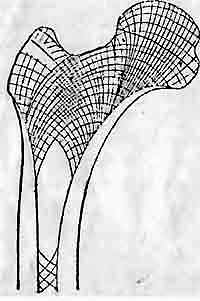
Look at the drawing where the technique of nature and the technique created by man are brought into communication. The figure shows the cut of the femur, the pressure lines are drawn, that is, the curves along which the force is transmitted, and, finally, the scheme of the effective forces in the arrow of the crane is shown. Engineers knowingly achieve what "instinctively", but appropriately attains nature!
I will give another example from the area of how the factory-organism works. It refers to the organs of our senses. The most perfect is the eye's eye organ. However, with respect to sensitivity, the sense of taste is superior to the eye: the tongue of a connoisseur of wines, if one may so express it, "laughs" at the finest chemical analysis. On the structure of the eye, it resembles a photographic apparatus that became an instrument of research only in the middle of the 19th century, you know that the frosted glass of the photographic apparatus and the sensitive photographic plate that is placed in its place to point the device at focus, is an imitation of the sensitive retina of the eye. Iologists go even further in comparing the process of vision with photography.
It is suggested that on the reticulated shell the same chemical modification of its surface layer is obtained, as in the film of the sensitive layer of the photographic plate, and the role of the so-called purple liquid of the eye is the role of the developer and fixer that cause images on the plate.
