Equality sign
Equality sign in mathematics and other exact sciences write between two identical in size expressions. The first to use the sign of equality was Diophantus. Equality, he denoted by the letter i (from the Greek isos - equal). In ancient and medieval mathematics, equality was designated verbally (for example, estegale). The sign of equality in contemporary form was created by the mathematician Robert Record (1510-1558) in his work "The Whetstone of Witte" ("Grindstone of Wit", 1557). He substantiated the use of two parallel strokes in this way: "...because no two things can be more equal" (because there are not two things that can be more equal).
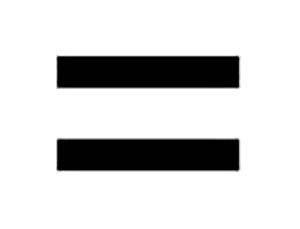
In fact, the sign of the Record's equality, which is now used by every schoolboy, the scientist has borrowed from medieval manuscripts. You can say that the Record is the founder of the English mathematical school. He was the first to write books on arithmetic, geometry and astronomy in English, and the first to introduce algebra in England. The record lived a short life. On his gravestone there are no words - just the "equal" sign is simply cut out.
In continental Europe, the sign of equality was introduced by Leibniz. One of the most important elements of a mathematical language is, besides the sign of equality, an identity. By identity we mean an equality that is valid for all values of the letters entering into it. The simplest examples of identity show the property of addition and multiplication natural numbers, which in the school is called "traveling law".
The corresponding identities are written in well-known formulas:
The sign of equality, as the concept of identity, can be considered universal in the "distance" covered by it in mathematics - from the very initial facts with which students of the lower grades are introduced, to major scientific achievements and discoveries. The sign of identity in the form of three parallel strips was first used by the German mathematician Georg Friedrich Bernhard Rieman in 1857.
In programming languages, the equal sign "=" is most often used for comparison and/or assignment operations. In some languages, the equal sign is used for both operations, depending on the context. In languages C, PHP, etc., "=" denotes an assignment, the equality is written as "==". In Perl, operators for comparing strings are different from operators for comparing numbers. In Pascal, on the contrary, "=" stands for equality, the assignment is denoted ":=".
