Mathematical symbols
Mathematical symbols of all known decimal fractions was introduced by the famous Dutch S. Stevin, who in 1585 published in Leiden a small brochure "The Tenth". However, the method of symbolism he adopted was extremely inconvenient. So, the number 8,937 he wrote without a comma, enclosing every even number in the circle.
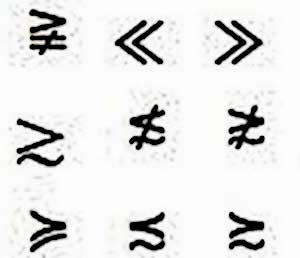
Modern mathematical symbols - the separation of an entire part of a comma or a dot - was proposed by the great inventor of the logarithms Scotsman J. Nepper in 1616-17. Familiar to us mathematical symbols of signs of addition and subtraction appeared at the end of the 15th century. Especially popular among them was the European merchant J. Widmann, who in 1489 published the essay "A Quick and Beautiful Method of Account for All Kinds of Trade." The writing was republished many times and quickly made the use of plus and minus signs ubiquitous. extraction from the root.
The real record-holder for mathematical symbols was the German mathematician G. Leibniz (1646-1716). It was he who introduced the designation of the action multiplying by one point, and division by two; introduced the term "function" into mathematics and became since 1675 to apply the symbol for integration. But it is interesting that the very word "integral" was invented not by Leibniz, but by one of his contemporaries by Jacob Bernoulli (1654-1705).
Mathematical symbols letters to denote the ratio of the circumference of a circle to diameter was introduced into mathematics by L. Euler. However, this is not entirely accurate. This sign began to be used in his writings by the Englishman V. Jones from 1706 onwards. But its wide application began after 1737, when the famous work by Euler "Introductio" came out.
