Muscle strength
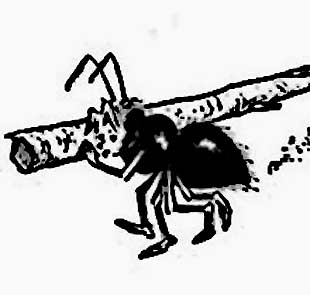
Observing the work of an ant, sometimes you ask yourself a puzzling task: where does this insect take such a muscle strength, so that it is ten times heavier than the body to drag the load without apparent tension? This is equivalent to a person running on a ladder, holding on his shoulders, for example, a piano - and, after all, the ratio of cargo to body weight of an ant is about the same. It turns out that the ant is relatively stronger than man?
To understand the relationship between the forces of an insect and a person, and also, what is their muscle strength, one must call for help geometry. At the same time, living muscle remotely can be compared with an elastic cord; only its reduction is based not on elasticity, but on other causes, and is manifested under the influence of nervous excitation, and in the physiological experiment from applying an electric current directly to the muscle itself. In the laboratory, such experiments were done on the muscles of a frog, as the muscles of cold-blooded animals retain their vital properties for a very long time.
For this, the muscle of the hind paw of the frog was suspended on the machine, and a hook was threaded through the tendon to which the weight was attached. If the muscle is touched by the wires coming from the galvanic cell, it will instantly contract, lifting the load. Gradual superimposition of additional weights easily determines the maximum lifting force of the muscle. If we connect two, three, four identical muscles along the length and start annoying them immediately, then the lifting force of the muscles will increase and the load will rise to a greater height, corresponding to the summation of the shortening of the individual muscles.
It turns out that if we tie two, three, four muscles into a bundle, or if the muscles are joined together, the entire system will, with irritation, raise and in the corresponding number of times a larger load. Therefore, the lifting force of the muscles does not depend on the length or the total mass, but only on the thickness of them, i.e., the transverse section.
Imagine two geometrically similar animals: the original and doubled in all linear dimensions. In the second, the volume and weight of the whole body, as well as of each of its organs, will be 8 times larger, but the cross section of the muscles is only 4 times larger. It turns out that the strength of the muscles, as the animal grows to double length and eight weight, increases only fourfold, that is, the animal has become relatively twice as weak. On this basis, the animal, which is three times as long, would be about three times weaker, and so on.
Taking into account the unequal increase in the volume and weight of the animal, it is explained why the strength of the muscles of the insect is relatively greater than in man. Ants can carry weights, at 30, 40 times the weight of their own body, while a person is able to pull normally only about 9/10, and a horse even less, namely 7/10 of its weight.
