Country Kush
Country Kush was located in the south, behind the Nile rapids and impassable sands, much of which now belongs to the Republic of Sudan. This rich state existed for at least a thousand years.
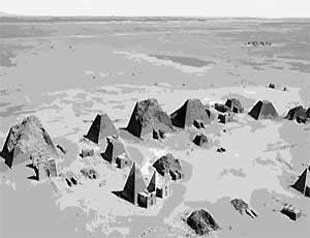
Ancient chronicles forced the first researchers in 1820 to go into the depths of the African continent in search of the country Kush. French scientists Frederic Cayo and Pierre Lethorse, after joining a group of Egyptian soldiers, reached Sudan, where they found traces of the mysterious civilization that they linked to the country of Kush. Before their eyes appeared whole fields of dilapidated pyramids, covered with sand, huge statues of the gods and the ruins of huge temples.
Again, the country of Kush was discovered by the American archaeologist James G. Brahsted, who in 1906 went on a journey up the Nile, and, having traveled a distance of 1600 km, brought with him 1100 photographs and sketches, still of immense scientific value.
It turned out that the country of Kush is closely related to the history of Egypt. The first written testimony of this country is the Egyptian inscription, carved on the rock at the 2nd threshold on the Nile. It says that King Zer conquered in 3000 BC. Lower Nubia. Another inscription says that in 2750 Pharaoh Snofru made a military campaign in these lands and repulsed the native land of the people of "Neches" (Nubians). Over the next 800 years, the country Kush becomes an increasingly important object for Egyptian expansion. Pharaohs sent here first military expeditions, then trade missions, and even later founded on this land fortress and factories. Finally, around 1570 BC the country of Kush was annexed to Egypt.
The conquest of the country by Kush by Egypt accelerated its eagaptization. Pharaohs built temples and cities up to the city of Kurgus, which stood 400 km south of Aswan. At the foot of the sacred mountain of Jebel Barkala was the capital Kush - Napata, where the Egyptians built several magnificent temples, decorated with statues and reliefs. Here was the residence of the Egyptian governors, who were appointed mainly from among the children of local Nubian leaders.
Borrowing the title of the pharaohs, the rulers of the country Cush accepted Egyptian funeral rites. They built pyramid tombs and colossal temples, although they had long since been abandoned in Egypt. The main religious center of Kush was the sacred mountain of Jebel Barkala. Here towered the majestic temple of Amun, greatly rebuilt by the king of Pianka.
The great builder was the pharaoh of Egypt and the country Kush Taharka, who died in 664 BC. Descendants of Taharka, expelled from Egypt, hoped to again take the throne of the pharaohs. But in 605 BC. after fierce fighting, the kushites were defeated, and the Egyptian troops ravaged Napata, after which the capital Kusha was transferred to the south, in Meroe. It is to the era of Meroe that the time of flourishing of local art is related.
The majestic ruins of Meroe consist of the ruins of the Temple of the Sun, the pyramids of the Western necropolis, where the famous residents of Meroe were buried. And still about a kilometer from this place towering hills of the royal pyramids. Here are buried the kings and queens, who ruled Kush from 300 BC.
The main deity Kush was the lion-headed god of war, Apedemac. He was portrayed in the form of a man or a snake with a lion's head. In honor of Apedemac, lion temples were built all over Kush. Such buildings have survived today and in Meroe.
In 250 BC the country Kush entered a new short bloom. King Ergamenez established and maintained friendly relations with the ruling Greek Ptolemaic dynasty in Egypt.
In 30 BC the Romans conquered Egypt and established their posts on the border with Kush in the region of Siena. But Roman expansion did not become a fatal blow to Kush. In the reign of King Netakamani, new temples and tombs were built in the country. The temple in Nagaa was also rebuilt, which became the last monumental building of Kush.
Today the question arises: what caused the country Kush to die from? One of the factors of Kush's death was the destruction of the soil, which undermined the country's economy. Erosion developed, and the remains of the soil were soon washed away. In addition, during this period, there were climate changes: a decrease in the amount of precipitation and the onset of a drought. Another factor was the impoverishment of Egypt during the reign of the Romans.
