Pliska and Preslav
The group of nomadic Turkic tribes, known under the common name of Bulgarians, first appears in historical chronicles at the end of the 5th century. The Bulgarian tribes wandered in the space from the lower Danube to the Caspian and the North Caucasus. In the 630-ies. "Great Bulgaria" was formed, which fell under the blows of the Khazars. Some Bulgarians migrated to the north, forming the Volga Bulgaria (Bulgaria), part - to the west, stopping in the present southern Bessarabia, and then crossed the Danube and entered Dobruja, on the territory of present-day northeastern Bulgaria. There was laid the beginning of the Slavic-Bulgarian state, the so-called First Bulgarian Kingdom (680-1018), whose capital was the city of Pliska.
At the turn of the 9-10 centuries. King Simeon, whom the Byzantines called the Emperor, moved the capital from Pliska to Preslav.
Today, in places where Pliska and Preslav, the ancient capitals of the First Bulgarian Kingdom, once stood, grass grows and the wind blows. Only here and there are the excavated remains of ancient buildings, abandoned or lonely columns, large stone blocks and other traces of the past.
Ruins of Pliska are located on the outskirts of the village of the same name, located 25 km north-east of the city of Shumen. The terrain where Pliska is located is completely flat, which is not typical for Bulgaria, but apparently it was to the taste of the ancient Bulgarians who came from the steppe Black Sea plains where they used to live. Founded in 681, Pliska, until its death, was the largest political and economic center of the First Bulgarian Kingdom. Alas, from this ancient capital little has been preserved to this day. In 811, Byzantine troops completely destroyed the city.
Archaeological studies of Pliska were started at the turn of the 19th and 20th centuries. Today the remnants of the ancient Pliska are quite fully opened and well studied.
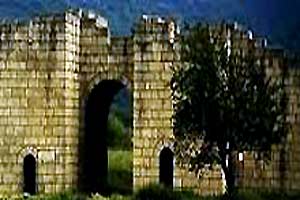
The city of Pliska was surrounded by an earthen rampart and a deep moat. A recently restored piece of defensive walls from large stone blocks and brick city gates give an idea of the powerful fortress that existed here. Under the protection of these defenses were the Grand Palace with the throne room, the Small Palace - the residence of the king, pagan temples, and then Christian churches, outbuildings, water tanks, etc. All the buildings were made of large stone slabs. To this day the constructions of ancient Pliska impress with a grand scale, a skilful system of water supply and heating.
The palace in Pliska, built by Khan Omurtag, was two-storied and occupied an area of more than 1500 square meters. It was decorated with columns and marble slabs. In the outer part of the city of Pliska there were numerous warriors, residential buildings, workshops, baths, water supply, there were even pastures for horses. Inside, there was another defensive belt: a 10-meter toothed stone wall two and a half meters in thickness. At the corners towered towers. The inner city of Pliska was built up by impressive buildings, here was the khan's citadel, also fortified by a powerful wall.
After the baptism of Bulgaria in 865, many churches were built in Pliska. Soon after this event, Tsar Boris founded the first monastery in Pliska. In the same years, the most famous of the Pliska churches was built - the so-called Great Basilica. Its length was 99 m, width - 30 m, the total building area - 2920 square meters. This was the largest building in ancient Bulgaria and one of the largest buildings in Europe at that time.
At the East Gate of Pliska there was once the Grand Palace, on the foundation of which the throne room was subsequently erected. A few meters from it rises a small (residential) palace, surrounded in ancient times by another wall of stone and brick.
During the excavation of Pliska in the layers of the 9th century, traces of the fierce fire were found. In all likelihood, this is one of the evidence of the pogrom, perpetrated by the Byzantine emperor Nikifor First Genik on July 21, 811. Breaking into Pliska, they did not just loot it, but also destroyed it to the ground.
The remains of the second ancient Bulgarian capital, Velikii Preslav (10th-11th centuries) are located 18 km south-west of Shoumen. The first stones in the base of Preslav were laid in 821 year. The Bulgarian builders erected the first city in Europe, protected by thick stone walls in the form of two concentric circles. The outer wall was 3,25 m wide and was built of white stone (limestone). The inner wall of the citadel with a width of 2,8-3 m protected the palace and administrative buildings.
Alas, Preslav's prosperity turned out to be short-lived. In 972, it was captured and completely destroyed by the troops of the Byzantine emperor John Tzimisce.
The nature of the architecture of the capital Preslav was in many respects reminiscent of the former, but it was distinguished by still greater wealth, splendor and elegance. The wealth of Preslav architecture is evidenced by the ancient descriptions that have come down to us.
Interesting attraction Preslav - Round or Golden Church (10 in). It is located on the right side of the Smolokuri street, on a steep slope, and is clearly visible from the bottom, from the center of the city.
The Golden Church in Preslav occupies a special place not only in the history of the ancient architecture of Bulgaria, but also in the history of Eastern Christian architecture in general. The plan of this church is unusual: it consists of a round rotunda with internal pillars (similar monuments are known in Transcaucasia). To him adjoins the porch with two round rooms on the sides (apparently towers), and to all this from the facade - a vast quadrangular courtyard - the atrium.
Even in the ancient chronicle, this church was called Golden, as the dome was gilded from the outside, and glazed pottery on a gold background decorated it inside. According to experts, this was the most outstanding from the architectural point of view construction of Great Preslav.
Like all the buildings of Preslav, the Golden Church reached us in ruins. The interior of this original church was once once extremely richly decorated with stone carvings, reliefs, mosaics and ceramic panels. The decoration of the church widely used precious metals and colored stones. The dome of the church sparkled in gold, the precious mosaics that adorned the walls glittered in gold.
Today, on the site of the former church in Preslav, against the background of a bright blue sky and green gentle mountains, only a few extracted marble columns that once adorned this amazing structure are white.
