Letters of the ancients
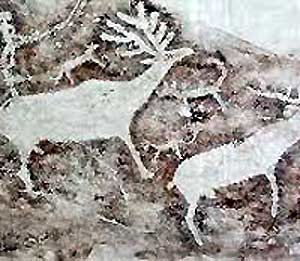
The very first letters of the ancients were written, or rather, cut down on their wall dwellings-caves primitive people. There are many places on the Earth where carved marks and drawings are preserved on the rocks, boulders, cave walls. They are called petroglyphs. Some of them are 5-10 thousand years old! Figures on stones, sometimes, just whole pictures: petroglyphs served as pointers, denoted borders of tribal possessions, hunting places. In other words, they transmitted information, which means that these are the first letters of the ancients.
The oldest letters of civilizations are the letters of the ancient Sumerians, found on the territories between the two rivers - the Euphrates and the Tigris. For a long time it was believed that it was they who had the first attempts to fix the information in writing. But some experts believe that the first letters ancient civilizations appeared much earlier, just before our time, information about this has not reached.
Over time, people realized that it is more convenient to write on raw clay tiles. And to fix the text they were dried in the sun or burned on fire. In Persia, during the reign of King Cyrus, there were even postal stations for the transportation of such ancient letters. But the clay letters of the ancients are heavy. In Athens, for example, the texts of state laws were cut out on large wooden cylinders. The Chinese burned their petroglyphs with a hot needle on bamboo sticks. And our distant ancestors-Slavs left us a legacy of "Vlasov's book" - mysterious letters of the ancient Slavs - a chronicle printed on 35 birch plaques. In Ancient Greece, then in Rome, and then in all of Europe, they wrote on wooden plaques covered with wax, in Russia they were called tsery. The letters on the wax were written with a pointed wand, the upper end of which had the shape of a scapula and it could erase what was written. On July 26, 1951, during excavations at Novgorod archaeologists drew attention to the amazing letters of the ancient Slavs - pieces of birch bark with scratched marks. Today there are more than seven hundred such finds. They told that not only noblemen, but even peasants and artisans were literate in ancient Novgorod.
The letters of the ancient Egyptians were fulfilled in papyrus, which served them more than four thousand years. In translation this word means "gift of the river". So called the reed plant growing along the banks of the Nile. Papyrus quickly conquered the whole world, but over time he had a rival - parchment (processed skin of young calves and lambs). The parchment was denser and stronger. And to write on it, unlike papyrus, it was possible from two sides. However, humanity needed cheaper and more convenient material for writing. And people invented paper.
There is reason to believe that the letters of the ancient Slavs long before Cyril and Methodius already had a prototype. Cyril and Methodius, according to a number of modern linguists and historians, were not the creators, but only the reformers of the already existing alphabet, based on the Greek alphabet.
There is also evidence that, in addition to the Greek Slavs, they had their own original system of writing: the so-called knot writing system. The letters of the ancient Slavs were not recorded at the same time, but were transmitted with the help of knots tied with threads, which were wrapped in coils-books. Perhaps these knots were conditionally depicted on ceramics, metal or birch bark. The memory of ancient nodular letters remained in the language and folklore. We are still tied up "nodules for memory", we say:"connect the thought", "connect the word with the word".
