Santorini island
Santorini island, which was halfway from Crete to mainland Greece, at different times had different names. The ancients referred to him as Tire, Strongili, and also Calliste. Covered with a thick layer of petrified volcanic ash and pumice, Santorini Island hides numerous evidence of the tragedies that took place here in antiquity. The thing is that in the Bronze Age on the island of Santorini, there was a highly developed civilization for its time. What kind of tragedy took place here?
This mysterious island scientists became interested in the 19th century. In 1866, the French volcanologist Fouquet explored the island of Santorini and the neighboring islet of Tirasu. Four years later another French scientist, archaeologist Gorsi, conducted the first trial excavations on Santorini.
Excavations of Gorsay found here stone tools, painted ceramics, millstones, bowls and stupas hollowed out of the hardened volcanic magma. In some vessels remained the remains of barley grains, peas, lentils. Bones of goats and sheep were found. Judging by the finds, the ancient inhabitants of Santorini used weights, we knew measures weight and length. In one of the excavated houses was even found fresco painting. All this said that in the Bronze Age on the island there was a fairly developed civilization that died as a result of several catastrophic eruptions of the volcano that destroyed the island itself and which caused the decline of the entire Creto-Minoan civilization.
The catastrophe erupted around 1500 BC. The center of the island of Santorin soared into the sky, and the sea immediately rushed into the gaping crater. The subterranean jolts were joined by hot ash and volcanic dust, which burned everything in their path. The fiery hail that fell to the ground turned it into an uninhabited desert. As a result of the cataclysm, a giant tsunami wave emerged, which swept away all the harbors and flooded the vast areas of the Mediterranean coast.
Archaeologist Spiridon Marinatos was convinced that the mystery of the destruction of the Cretan-Minoan civilization should be sought on the island of Santorini. In 1967, the scientist began to excavate a large ancient settlement located on the southern tip of Santorini.
Within a few hours of work, the first fragments of apparently Cretan origin fell into the hands of archaeologists, and then the inner walls of the destroyed house began to appear from under the earth. A thick layer of white volcanic ash, like a shroud, covered the ruins.
This was the second major discovery in the history of the Cretan-Minoan civilization. Marinatos discovered the remnants of the present Minoan Pompeii: the ruins of stone houses, palaces and sanctuaries of the 2nd millennium BC, buried under a layer of volcanic ash and pumice up to five and a half meters thick. It was a city with a population of 30 thousand people, with buildings in two or three floors, with a heating system that used the warm waters of the volcanic island, with numerous workshops and warehouses. Most of this city after the catastrophic eruption of the volcano plunged into the water...
The further the archaeologists excavated, the clearer the streets of the ancient city appeared in front of them. The houses here resembled the Cretan buildings: comfortable, spacious, with large windows, with bathrooms, all decorated. Some houses had lobbies with benches, there were also houses with loggias.
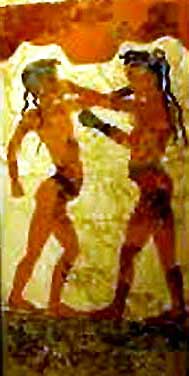
But all the finds made on the island of Santorini, turn pale in comparison with the frescoes, opened during the clearing of one of the buildings, the total area of which was 13,5 square meters. Written in bright colors, even after three and a half thousand years, which did not lose their pristine fresh colors, these frescoes undoubtedly surpass everything that has been discovered so far in the Mediterranean region.
But did not the catastrophe that occurred in the Eastern Mediterranean around 1500 BC, reflected in Plato's famous myth of Atlantis? As early as 1872, the French scientist Louis Phitier, relying on the discoveries made on the island of Santorini, suggested that Platonic Atlantis should be sought in the Aegean Sea. Probably, the prototype of Atlantis could serve the island of Santorini, part of which was indeed almost instantly flooded by the sea.
