Chavin culture
The earliest pre-Inca culture in the territory of Peru, whose representatives built the first cities on this earth, was the Chavin culture. This is the first highly developed Indian culture. Its name was given by the name of the locality Chavin de Huantar, located at an altitude of 3048 m in the north of Peru.
The scientists established that the Chavin culture arose around the end of the 2nd millennium BC. From the 9th century BC. The Chavinians began to grow corn and a number of other cultivated plants. In the same period, the dog and the llama, an animal that was of paramount importance in the life of the Indians during the pre-Columbian period, were tamed. At the same time, archaeological excavations have shown that the tools of the Chavin culture were of stone or bone.
Chavin de Huantar is considered today the oldest city in South America, though not in the modern sense of the word. Most likely, it was only the main religious center of the country, in which only the priests constantly lived. He was the center of a local religious cult - the worship of a deity in the form of a predator from the family of felines. The stylized images of this "cat god" have been preserved on dozens of vessels and steles, but the highly conditional manner of image transmission does not enable us to accurately determine which animal this is: the puma or the jaguar? Most scholars hold the view that the Chavin culture worshiped the cult of the jaguar.
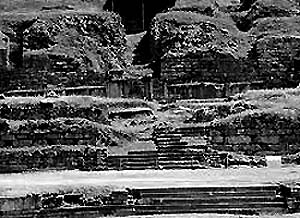
Chavin de Huantar consists of many stone temples with an area of 50 hectares and associated structures erected on the terraces of surrounding hills to which the water was laid. It is believed that the building material for the construction of the sanctuaries was brought by pilgrims who came here at the time of major religious festivities.
To the period of the heyday of Chavin culture is the magnificent three-level pyramid temple "El Castillo", as well as the strange stone gallery in Cerro-Sechin - a series of stones adorned with carved human figures. The height of the pyramid is 13 m, and the area of its base is 72x75 m. The pyramid is decorated with carved out of the stone heads of jaguars and some fantastic creatures. Inside the building there are a whole labyrinth of chapels, a system of ventilation shafts and twenty-four underground corridors that do not lead anywhere.
Trying to explain the many parallels between the Chavin culture and the early Mexican civilizations, as well as the "explosive", unexpected nature of the Chavin culture, many experts believe that the roots of Chavinians should be sought in other areas of America, and especially in Mexico. Another circumstance also supports this conclusion: simultaneously with the emergence of the Chavin culture in Peru, maize is unknown until then, while in Mexico it was grown two thousand years before. However, all this is just conjecture, and the mystery of the origin of Chavin culture has not yet been revealed. And the traditions of this culture were later perceived and developed by other Andean civilizations, including the most famous Inca civilization.
