Celts
Hallstatt is a small town in Upper Austria. In 1846 Georg Ramsauer discovered in the vicinity of Hallstatt an extensive ancient burial ground. The findings made by him were sensational: they testified to the existence here in 700-500 years BC a civilization that used iron!
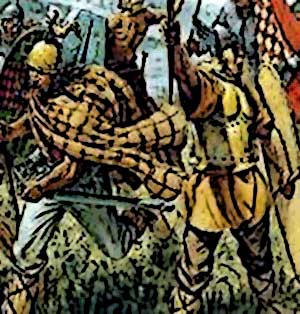
What kind of people lived in this remote mountainous region? It's about celts. It is here, in the mountainous region of Austria, around 700 BC. formed early Celtic culture. Due to the diversity and richness of archaeological material, this culture was called Hallstatt.
The Celts first mention Greek historians of the 5th century BC. Hecataeus of Miletus and Herodotus. Later, the Romans called the Celts Gauls, and the lands inhabited by them - Gaul. In the period between the 6-3 centuries BC. Celtic tribes inhabited northern Spain, Britain, southern Germany and the territory of modern Hungary and the Czech Republic.
The Celts were at a fairly high stage of development already in the 8th - 7th centuries. BC, and later, between 500-250 years BC, reached the peak of its heyday. Then began the gradual decline of their influence and power under the blows of the rapidly rising Rome. From the Celtic lands only Ireland and Scotland remained unaffected by the Roman Empire.
Two Celtic periods are known in the history of Europe. The first is the ancient Celts of the Iron Age, contemporaries of Ancient Greece, the empires of Alexander the Great and the Roman Empire, which the Romans gradually ousted to the British Isles. The second period is the Celts Christians, the successors of the ancient Celts who lived in Ireland, Scotland and Wales.
Their leaders were buried in magnificent burial chambers laid out of logs (most often used for this purpose was an oak, considered a sacred tree), under bulk mounds, which were crowned with a statue of the deceased in full growth, an image of a deity or a headstone and a ritual steloi. In the graves of the Celts laid richly decorated horse harness, expensive jewelry, gold crowns and diadems, bronze vessels and numerous pottery, simple - local work and painted Greek. Celts believed that the grave of man is a kind of vestibule to the desired life after death.
The ancestor of the ancient Celts was uncomplicated. Their dwellings are a wooden house with a floor deep in the ground (semi-dugout), covered with straw. Such huts were a village or a village, not protected from enemy raids. During periods of frequent wars, the Celts sought refuge in standing on an elevated, well-fortified hillfort. These places, protected by a rampart, a wall made of logs and stone, and a moat, was called "oppidum".
The original treasure of the applied art of the Hallstatt Celts is a collection of ceramic vessels from the mounds near Sopron (Hungary). On these vessels, one can see images of men fighting in ports dressed in ports (a typical feature of the "barbarian" world) and cloaks that flow freely.
Hallstatt culture was the forerunner of the culture of the "classical" or "historical" Celts. It is with them that the era of the heyday of Celtic power is connected - between the 600s and the 220s. BC, when the possessions of the Celts stretched from the Baltic to the Mediterranean and from Black Sea to Atlantic Ocean. Celtic culture of this period - from the middle of the 6th century BC. and further - received in science the name of the Latin. The first discoveries of the monuments of this culture were made in the settlement of Laten, located in Switzerland.
Approximately from 400 BC. Celts became the dominant force in the areas located north of the Alps - from France to Hungary. However, the ancient Celts were not a single nation and did not establish their state. They lived separate tribes and principalities, sometimes tribal federations were created. Further, this political unity did not enter them. Many of the largest modern cities in Europe were at one time laid by the Celts. These include London, Dublin, Paris, Bonn, Vienna, Geneva, Zurich, Bologna. Lyon, Leiden, Milan, Coimbra, Belgrade.
The whole culture, populated by the Celts, was dominated by a single culture and a single language (with dialectal differences). However, the ancient Celts did not have a written language.
Celts deified the phenomena of nature, rivers, mountains, animals; among their gods were triliki deities, snakes with a ram's head, small spirits-gnomes; in addition, there were many local gods. In doing so, the Celts very rarely depicted their deities in human form - obviously, in this respect they had a taboo.
In the obschekeltsky pantheon, the god of the sky Taranis was worshiped, the goddess was the patroness of the horses of Epona, the triad of goddesses-nurses. There were Celts, besides the main gods, and numerous other deities of various kinds, as well as spirits - keepers of sacred springs and groves.
The cult of the dead head is also associated with the religious beliefs of the ancient Celts. Probably, the severed heads of the enemies were not only the most significant trophy of the winner, but also had a religious meaning, so the skulls were kept in the sanctuary.
On the territory of modern France, the Celtic tribes had several sacred places, where the tribal chiefs regularly gathered to perform religious rites. One of the most important places was Lugdunum (Lyon). And in the area of Orleans, probably, was the sanctuary of the Druids - the Celtic priestly caste, the teachings and rites of which the participants of the sacred actions were kept in strict secrecy.
All the evidence of the Celts speaks of a clear division of Celtic society into three main classes: "noble" (priests, soothsayers, poets, warriors), free artisans and farmers, and finally slaves, who made up the majority of the population. Relations between the three classes of Celtic society were carried out within the framework of the so-called Celtic law - a very ancient and most complex of European legal systems, with which even the Romans were compelled to be considered. Celtic law established for each member of society, however low its position, certain rights; a person was deprived of the protection of the law only when he committed a serious crime - he was excommunicated from participation in sacrifices, and the tribe renounced him, condemning the life of an outcast.
Celts loved beautiful things and spared no effort and skill in making even ordinary kitchen utensils, decorating it with elaborate ornaments. They were unsurpassed masters of minting for metal. Celtic jewelers owned different ways of processing metals. In their products, the tendency to complex ornaments is clearly visible.
The Celts abandoned their invisible, but still felt, imprint on many countries that arose later, where the fortified settlements of the Celtic tribes were located. And their distant descendants living now in the western part of the British Isles and in Brittany (France) managed to preserve to this day a number of original elements of their ancient culture.
