Pueblo Indians
In the 7th-8th centuries AD, in an era of decline in the culture "basket makers", in Arizona is formed a new culture, which the Europeans gave the name "pueblo" - "inhabitants of the rock towns". Their culture was the last, highest, step in the development of the pre-Columbian cultures of North America.
The Pueblo indians were skilled potters and weavers. But, first of all, they are known as magnificent agronomists, who managed to get extremely poor yields on extremely poor lands thanks to amazing irrigation facilities. They cultivated corn, tobacco, grew a pumpkin, red capsicum, lettuce, beans. Fields of Indians pueblo treated with a wooden hoe.
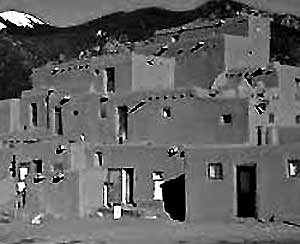
The Pueblo indians built their cities under steep rocks, either in deep river canyons, or directly in cliffs that grew horizontally and vertically up to four or five tiers. The largest known rocky settlement is the famous Mesa Verde (Colorado).
However, the "city" of the Pueblo Indians was more like one big house-hive: each room was clinging to the other, and all together they represented a giant building, similar to honeycomb combs and numbering several dozen or even hundreds of living quarters and sanctuaries. So there were the cities of Pueblo Bonito in the canyon of Chaca, Pueblo Penjaska Blanca (five kilometers from Pueblo Bonito), Pueblo Pintado (in the Chaca Canyon), and others.
Everywhere in the rock towns, the Pueblo indians, along with rectangular living quarters, also built round structures. These are sanctuaries bearing the name "kiva". They were built exclusively by women, but they were strictly forbidden to enter there.
The flowering of the pueblo culture occurred in the 10th-14th centuries AD, and its decline was designated by the year 1400. For no known reason, the Pueblo indians began to leave their hollowed out cities in the rocks, and build new settlements on flat, steeply descending elevations called Mesami.
The new settlements of the Pueblo indians preserved in many respects the features of the ancient rock towns. They also formed like honeycomb: the house grows to the house, and so a huge "city" is formed. Today, the inhabitants of such cities, regardless of their language, are also called Pueblo indians.
The pueblo culture came to a final decline with the arrival of the Spanish army led by F. Vazquez de Coronado, who was looking for seven mythical cities of Sivola. However, until the middle of the 19th century, the Pueblo indians did not come in close contact with the whites and thus preserved, without significant changes, the characteristic features of their culture, which during the last six to eight centuries did not undergo any qualitative changes.
