Chinese "Valley of the Kings"
The city of Xi'an, the capital of China for almost the entire first millennium AD, was a huge rectangle with a perimeter of 36 km and an area of 8410 hectares, and intersecting at right angles, dividing Xian into quarters - the Imperial City, where the main administrative buildings were located; Forbidden City, where the palace of the emperor was located; temple and trading parts; residential quarters. But, Xian is famous for others. In the vicinity of it there are many tombs of Chinese emperors of different dynasties - a real Chinese "Valley of the Kings".
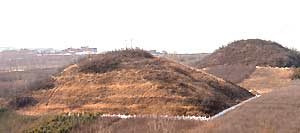
Chinese "Valley of the Kings" stores whole dynastic complexes of burials: the tombs of nine of the eleven emperors of the Western Han dynasty (202 BC - 9 BC). It was in this Chinese "Valley of the Kings" in the ruins of the palace built during the Qin Dynasty (221-202 BC) that the most ancient wall murals in China were discovered today.
Notable people, according to the customs of ancient China, were buried in underground constructions made of wood, stone and brick. Each such tomb in the Chinese "Valley of the Kings" was a real underground palace, the size of which depended on the dignity of the deceased. Underground halls of tombs were divided into separate rooms and rooms. Silent figures of stone guardians of tombs stood silently at the door, the capitals of columns were decorated with gilded figures of dragons, walls covered with reliefs depicting various mythological scenes. Filled with gloomy grandeur funerary halls filled thousands of objects: bronze mirrors, censers, lamps, vessels, cloth, painted clay figures of dancers, musicians, servants, clay models of estates, multi-storey houses and towers.
The Chinese "Valley of the Kings" is widely known for its finds of "clay armies", of which the most famous is clay army of the emperor Qin Shihuandi. But it is by no means the only one. In 1970, Chinese archaeologists discovered the tomb of the Emperor Gaozu, whose entrance was guarded by an army of painted clay figures 45 cm high.
In 1968, the Chinese "Valley of the Kings" opened a new sensational find to the world. During the construction work, soldiers of the Chinese army accidentally discovered an underground passage. The tunnel led to several grottoes, which turned out to be... rooms of a huge underground wooden palace covered with tiles. In the underground halls of this amazing palace was everything the ruler needed in the afterlife, while the funeral inventory was made with appropriate luxury. Before the eyes of the scientists appeared stables, storerooms for meat, grain, fruits and vegetables, a grand hall for feasts and solemn ceremonies (its arch went up seven meters), as well as a bathing-place. Nearby there was a tomb itself, where there was a wooden coffin covered with varnish and decorated with nephritis.
Here, in the Chinese "Valley of the Kings" two thousand years ago was buried Liu Chen, brother of the then-emperor Udi (140-87 BC) and the ruler of one of the provinces of the Middle Empire. For his wife, Princess Du Van, he also ordered the Chinese "Valley of the Kings" to erect a similar mausoleum a hundred and twenty meters from his tomb. Both underground palaces were directly treasures: in these burials archaeologists discovered two-wheeled carts, bronze lamps and chickens, silk fabrics and jade knick-knacks. Especially struck scientists burial attire of Princess Du Van. It was "sewn" out of 2156 jade plates, fastened gold threads. According to the then beliefs, nephrite saved the body of the deceased from decay.
