What is a treasure?
What is a treasure? The answer to this question should be sought in history. Virtually every ruler of any country in the world has always wanted prosperity for himself, but spoke about the prosperity of the whole people. Since everyone wanted everything, but there was not enough for everyone, people simply acted - they were looking for the enemy and declaring war on him. Those against whom the war was waged, hid their savings in various forms "until better times". That is, they hid the treasure. With a few exceptions, the best times never came. And the treasure was lost for its master forever. This is the law of our harsh life! And the positive is that the hidden treasure-treasures returned to a completely different era to quite different people. This also has its own law - the treasures return to the world unexpectedly and in the most unexpected place.
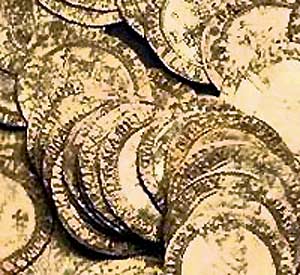
What is a treasure, that is, its definition, can be different. In the book of V.V. Zvarycha "Numismatic dictionary" means "a certain amount of money in the form of metal coins, most often in a vessel, usually clay, wrapped in cloth, leather, etc., hidden in the ground, in the hollow of the tree, under the foundation of the building, etc". Quite a limited understanding! In other sources we find a more general definition: first of all, "gold and silver coins, objects and various utensils from these metals, less often - precious stones" (Tsybin VD Plotted treasures and treasure hunters). It is simpler to define the term "treasure" of the Civil Code of 1832 - "a treasure is a treasure hidden in a land or structure". In our, Slavic countries, where the people did not have enough time to accumulate between the wars, the treasures most often consisted of copper coins, rarely gold and silver. In ancient texts the word "treasure" was not used, it was introduced for the first time in 1645 in the description of one criminal case related to the found treasures. Before that, the word "put on" was used most often, but "treasury" and "scab" were often met.
The laws of most countries on the found treasures are based on the code of civil law, which was formulated in Byzantium in 533 AD. by the decree of Emperor Justinian. Part of the code of treasures was called Latin Digest or the Greek language of the Pandect. Approximately this law read as follows: I found a treasure in my land-own it completely, in a foreign land-own half of it.
The most significant treasures found in this or that place or at this or that time have a certain name. Most often it is given by the name of the locality near which it was found, or by the name of the head of the search group or the event sponsor. And the hidden treasures most often bear the names of the owners who hid them. These treasures and do not give rest to the army of search engines.
According to British law, the treasure discovered is owned by the state; the person who finds it is obliged to report it to the state authorities within 14 days, and non-reporting entails criminal liability. The state can pay monetary compensation established by independent experts (usually equal to the treasure hunter and land owner), or to return the treasure to the treasure hunter. In the United States, hoarding legislation varies widely between states. In most states, the treasure found on private land usually belongs to the finder; in other states (for example, in Idaho and Tennessee) it always belongs to the owner of the land; and in Louisiana the treasure is divided equally between the treasure hunter and the landowner. A treasure of more than a century old, found on the federal land, is considered an archaeological value and belongs to the federal authorities.
